

For first-time Family Entertainment Center (FEC) investors, sourcing indoor playground equipment is not just about finding the lowest price. It is about understanding supplier capabilities, safety documentation, design quality, installation support, and long-term project reliability.
A good sourcing process usually starts with research, comparison, and careful supplier evaluation. Local showrooms can help you understand product quality and market expectations, while experienced overseas manufacturers may offer more flexible customization, project-based design, and factory-direct production support.
Step 1: Visit Local Showrooms to Complete Your “Sourcing Initiation”
For first-time buyers, we highly recommend searching Google Maps for a nearby “Indoor Playground Equipment Supplier” or simply visiting a few thriving local indoor playgrounds.
Don’t rush to place an order; treat this as an immersive learning experience:
Feel the materials firsthand: Truly good products can be felt. Squeeze the soft padding to check its density, inspect the PVC covering to see if the stitching is flat, and shake the galvanized steel pipes to gauge the overall frame’s stability.
Understand “what truly matters”: Observe how others handle anti-collision corners. How dense is the safety netting for high-altitude attractions? These details will become your benchmark for evaluating equipment quality in the future.
Get a firsthand quote: Request an initial quotation from a local distributor. This not only gives you a baseline for your overall budget but also serves as a crucial price reference anchor when you later search for online suppliers.
Step 2: Go Online and Enjoy the Absolute Advantage of “Comparison Shopping”
Once you’ve completed your foundational learning at physical stores and have a solid grasp of quality and pricing, online channels will reveal their powerful advantages.
The internet brings together the world’s top source manufacturers. By bypassing the middlemen markups of local distributors, you can easily compare multiple options and acquire custom equipment with cutting-edge designs and richer play features—straight at factory prices.
However, with a vast sea of online suppliers, how do you accurately filter out the truly high-quality manufacturers?
Step 3: How to Screen Suppliers When Deciding Where to Buy Indoor Playground Equipment?
When evaluating online factories, please look past the flashy website packaging and assess them directly using the following five “pain point metrics” that clients genuinely care about:
1. The Primary Core: Do They Provide “Pretty Pictures” or “Hardcore Specification Sheets”?
This is the most critical yet easily overlooked aspect of online sourcing. Many unprofessional trading companies can only send you attractive 3D renderings, but these are meaningless. When applying for building and fire permits from your local municipality, the government looks at the data.
The Professional Manufacturer’s Approach: In the early design stages, they provide you with detailed, automated Technical Specifications. What is the wall thickness of the steel pipes? Does the fire retardant rating of the soft padding meet standards? Where is the load-bearing test data? Eliminate any supplier who cannot produce these hardcore metrics.
2. Design Draft Pitfalls: Distinguishing a “Practical Good Design” from an “Impractical Pretty Picture”
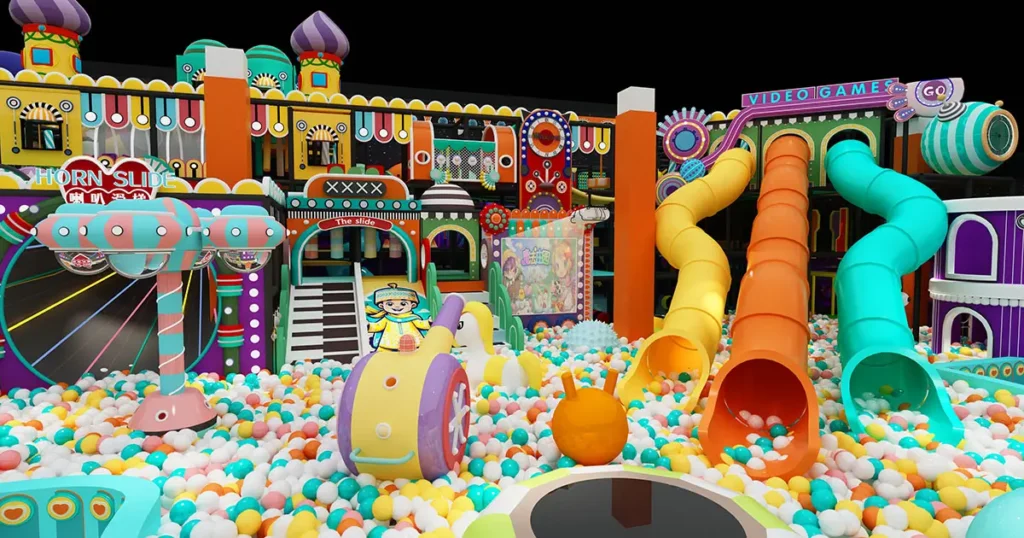
Many novice buyers are easily swayed by colorful 3D renderings. But remember: pretty does not mean practical, nor does it guarantee profitability. Amateur suppliers merely “pile up equipment blindly,” whereas professional manufacturers perform true “commercial space planning.”
Evaluation Points (Tips for Reading Designs):
Check Site Restoration Accuracy: Professional design drafts will precisely mark your venue’s load-bearing columns, fire exits, and even ceiling pipe heights; the equipment is tailored to fit the site perfectly. Deceptive “pretty pictures” often have empty backgrounds, leading to endless collision issues during actual installation.
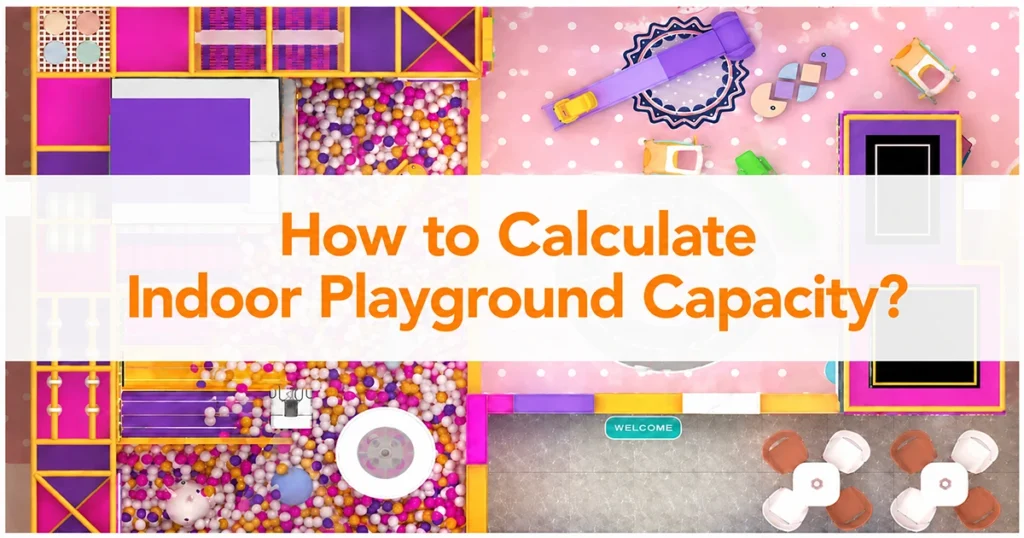
Evaluate Space Utilization: Rent for indoor venues is incredibly expensive; every square meter must generate revenue. Unprofessional blueprints often leave large dead zones or useless gaps. Top-tier designs ingeniously utilize the venue’s vertical space (planning multi-level structures) and irregular corners to maximize the facility’s peak capacity without compromising safety distances or feeling overcrowded.
Analyze Traffic Flow Layout: This is the core factor deciding whether your future store operations will be chaotic. Excellent drawings map out extremely clear “multi-dimensional traffic flows”: a smooth path from the shoe-changing area to the main equipment, non-intersecting high-intensity play routes for children (to prevent collisions), and explicit evacuation routes for emergencies. Amateur designs often lead to severe bottlenecks at entrances and exits during peak weekend hours, triggering customer complaints.
Assess Scientific Zoning and Clear Sightlines: A good design must feature strict “age zoning” (physically separating toddler soft play areas from older kids’ extreme zones). Simultaneously, it must maintain clear sightlines for parents and staff. If a design is filled with fully enclosed, massive castles, it indicates a highly dangerous blind spot for safety supervision.
3. International Safety Certifications: Proof Over Promises
Playgrounds are spaces for children; safety compliance is an uncrossable red line.
Evaluation Point: You must require the factory to present authentic international safety certifications, such as North American ASTM standards or European CE/EN1176 standards. A genuine top-tier manufacturer will not only have certifications for the overall structure but also authoritative environmental and safety test reports for accessories like floor mats and safety nets.
4. Implementation Guarantee: Is There a “Pre-installation” Process at the Factory?
This is a massive pitfall countless buyers have fallen into: equipment travels across the ocean to the venue, only for you to discover misaligned holes or missing parts, bringing the entire project to a halt.
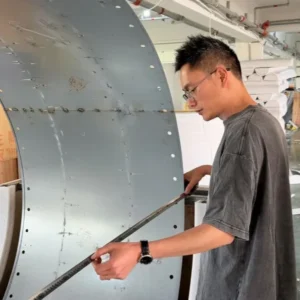
Evaluation Point: Explicitly ask if the manufacturer provides pre-installation before shipping. A rigorous manufacturer will pre-assemble complex steel structures and slides in their own factory, take detailed photos and videos for your confirmation, and then disassemble and pack them for shipping. This reduces the error rate of on-site installation to the absolute minimum.
5. Delivery Capability: Who Will Help Me Assemble This Pile of Parts?
The installation of large playground equipment is highly complex; a few simple instruction manuals are absolutely insufficient.
Evaluation Point: A premium supplier must provide “concierge-level” installation support. They should not only offer numbered 3D installation blueprints and detailed video tutorials but also possess the capability to dispatch overseas engineers or coordinate with local installation teams, solving the “last-mile” delivery challenge for you.
Conclusion: Be a Smart Investor
Sourcing large indoor playground equipment is a game of rational calculation. Learn the standards at local physical stores, and lock in ultimate cost-effectiveness and professionalism with online source manufacturers.
As a professional indoor playground equipment manufacturer deeply rooted in the B2B sector, Leban Play acutely understands the pain points of first-time buyers. We not only provide direct-source goods that meet international standards but also offer rapid and practical commercial space custom planning, rigorous technical specification sheets, and reliable installation support—ensuring every inquiry you make is grounded and worry-free.